
Quick Answer:
Many herding breeds can do very well around poultry, especially calmer heritage breeds like Old-Time Scotch Collies, English Shepherds, and well-bred Rough Collies. These breeds can be calm and gentle—especially when compared to higher-energy breeds that were meant to work with larger livestock (like cattle).
Herding breeds were bred to essentially chase livestock. So why get a herding breed if you have poultry?
Great question. Read on to learn why I think some herding breeds are the perfect addition to small homesteads—or anyone with a backyard flock.
Should you get a herding breed if you have chickens or ducks?
Many people will argue that anyone who wants a dog that will behave and potentially even protect their poultry should get a livestock guardian dog (LGD) breed. This includes Great Pyrenees, Anatolian Shepherds, Meremma Sheepdogs, and the Akbash breed.
And if you want a full-time livestock guardian, then yes, I would absolutely recommend looking into getting an LGD breed.
An LGD might be a great fit if you:
- Have a huge acreage
- Have exceptional fencing
- Want a 24/7 watch dog
- Want two very large dogs (LGDs do best in pairs)
- Are ready to dedicate about two years or more to training
If you answered yes to all or most of those questions, then a LGD might be the perfect fit for you. If that doesn’t sound like what you want, keep reading, because a herding breed could be exactly what you’re looking for!
A herding dog can be a part-time helper and companion
Herding breeds can be very adaptable. They are also generally more biddable, making them easier to train than independent LGDs.
If you want:
- A pet that will spend plenty of time indoors with you
- A smart, multi-purpose dog that will join you for daily chores
Then a herding breed might be a good fit!
What success around poultry can look like
For me, I wanted a pet that could join me for daily chores and activities. A bonus would be if they could actually help me with daily tasks—for example, protecting poultry from predators.
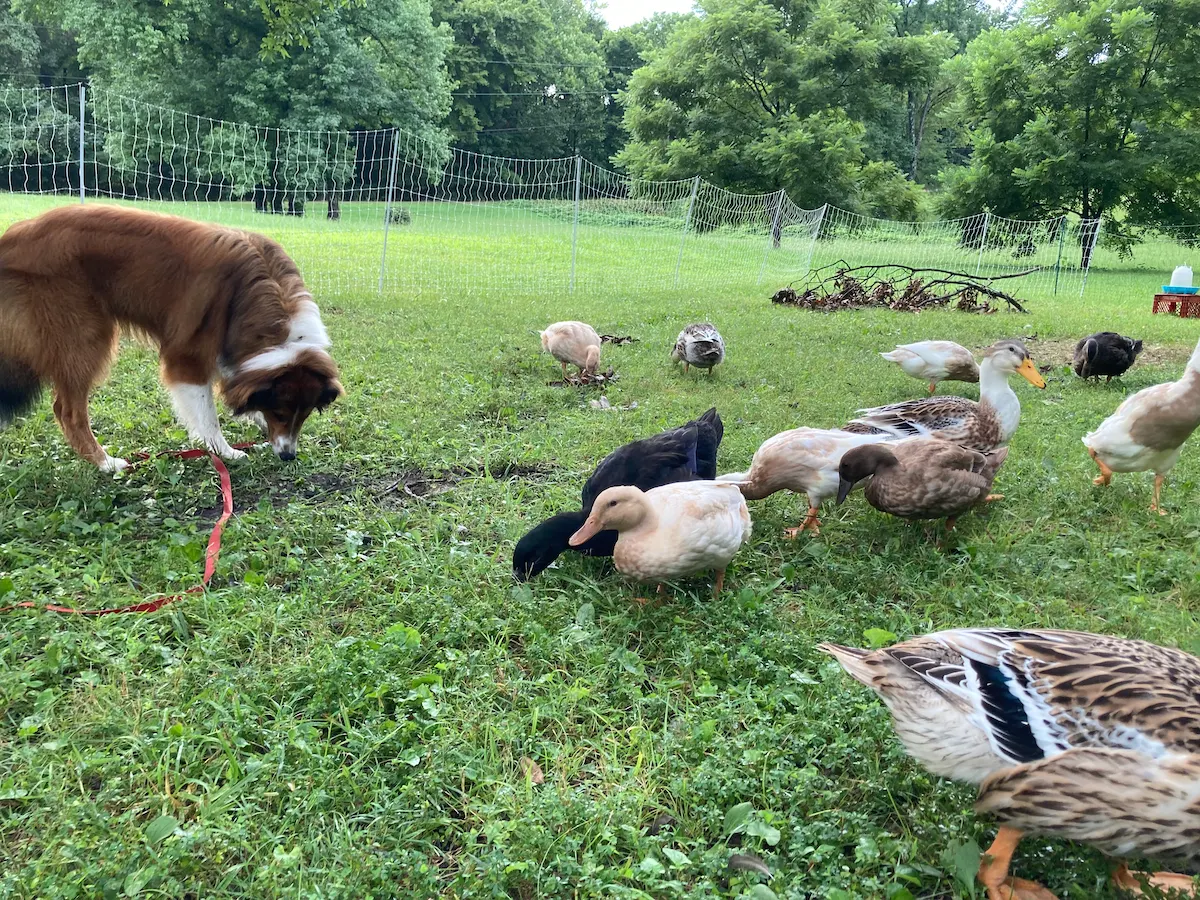
Maisie, one of my dogs, has an excellent herding drive and prey drive. But she’s mostly a pet, and at the end of the day, I want to enjoy relaxing outside with all my pets: ducks, chickens, cats, and dogs.
For me, this video shows what success looks like. A calm herding dog can be a great choice if this looks like “the dream” in action.
Keep in mind that breed is only part of the equation. You still need to put in the work—learn about how to train a herding dog around chicks and ducklings.
The 3 types of herding breeds: gatherers, drivers (heelers), or tending herding breeds
There are three main types of herding breeds:
- Gatherers / fetchers (e.g., Border Collies): Circle animals to bring them back to the handler.
- Drivers / heelers (e.g., Cattle Dogs, Corgis): Push livestock from behind, often using heel-nipping.
- Tending breeds (e.g., German Shepherds): Act as living fences to keep stock in designated areas.
Within these groups, different breeds may work best with certain types of livestock or have unique herding traits. Understanding what a breed was bred to do will help you understand how they may interact with poultry. For example, cattle dogs were bred to be rough and fierce—this can backfire when working with poultry. That doesn’t mean they can’t be trained around poultry, it just might take more time and patience!


Prey drive vs herding drive
A lot of people see herding drive as prey drive. I think it’s very important to understand the difference before you bring a herding dog home.
This is my simplified definition of each:
- Prey drive: The desire to chase and kill.
- Herding drive: The desire to move or direct.
Herding drive is an amended version of prey drive—developed over hundreds of years by breeders encouraging a herding drive that stopped short of killing.
My second dog, Maisie, has a wonderful herding drive. She can be very gentle at moving our ducks, but I’ve had multiple people comment on how bossy she is.
That’s because a really great herding dog can assess a situation and make their own decision—I think that’s where the “bossiness” really comes out. These are dogs that understand their job and know how to get things done! They have a desire to keep livestock in order, without harming them.
Not all herding breeds are going to have that “bossy” gene, but I think it’s a helpful way to better understand the difference between prey drive and herding drive.
Herding instinct is an incomplete predation sequence
The full prey drive sequence goes something like this: orient → eye → stalk → chase → grab bite → kill bite → dissect → consume. This is a sequence outlined in Applied Animal Behaviour Science’s paper on the Ethogram of the predatory sequence of dogs.
While there is some debate over how rigid this sequence is, I’ve simplified it in the chart below to what I think are the most essential aspects to notice when working with your herding dog. I’ve changed grab-bite to nipping, since that’s the common herding term. I’ve also dropped orienting (when your dog notices the animal) and dissecting (this one is well past the point of no return) to keep things succinct.
Herding breeds use their eyes and body language to apply pressure to livestock. This is the “eye” step—it’s locking onto the animal. However, hunting predators are not trying to move livestock, instead they are quietly focusing on their prey, preparing for the hunt.
Similarly, herding breeds chase, but the goal is not to kill—it’s to move livestock.
Breeders have intentionally kept and bred dogs that showed a strong herding drive—but that stopped short of killing livestock. Some breeds, like heelers and corgis, were bred to work with large livestock, and they retain more bite or “heeling” instincts. While this is a more confrontational herding style, this herding style is still an incomplete prey drive sequence because they do not bite to kill.
While breeding helps improve herding training, it is no substitute for training. I’ve heard of border collies with great instincts that helped herd livestock, never bothering poultry—until they got bored. High energy breeds (like border collies) need consistent training and regular jobs to keep them from becoming destructive.
How to tell prey mode from herding mode
Knowing this, it can be hard to distinguish between prey mode and herding mode. Here are a couple signals I watch for so I know when to step in:
- Zeroing in one animal: An essential part of herding is keeping a group of animals together. If your dog focuses on one animal, it is often a sign that they are using their hunting instincts—not their herding instincts. It can also mean your dog hasn’t developed their herding skills, so also pay attention to body language when this happens.
- Reckless, uninhibited energy: When your dog is bounding with energy, has zero inhibitions, and is no longer listening to you. This is often accompanied by grabbing or biting. This is where a long line and/or herding stick comes in—you can remind your dog to be aware of you and to work in a more controlled manner.
It is always a good idea to train your dog in a controlled setting where accidents can be prevented. Teaching your dog to respond to your commands, even when livestock is around, helps keep your dog in check.
Loose-eyed vs strong-eyed herding breeds
When most people think of working herding dogs, they often picture a border collie.
Border collies became the preferred herding breed as farms got bigger and more specialized. This led to a need for dogs that could herd all day in large, open spaces.
Border collies are known for their “strong-eyed” herding style, often seen when they are in a crouched position. Kelpies are also known as strong-eyed herders.
Loose-eyed herders use their body language to move a herd. They are more likely to bark as a way of communicating with livestock. This loose-eyed style tends to make working in smaller areas easier, since these dogs are more likely to bump or nip at livestock to move them.
Understand how your herding dog communicates
Even if you have a soft-eyed herding breed, there may be times when your dog looks like it’s going into full-on stalking mode. Don’t immediately assume the worst.
The more you understand how to move and direct your flock, the better you will understand your dog’s body language around poultry.
Take time to watch and see how your dog communicates with your chickens or ducks.
I would look for breeders that already have working dogs and who ideally introduce their puppies to poultry before placing them with families.
Picking a herding breed puppy that won’t harass your chickens (too much)
If you are looking at getting a puppy, you are at a great advantage! You can already get a sense of a dog’s behavioral tendencies before they’re ready to come home with you (between 8–12 weeks).
When picking out a puppy, I would look for:
- A puppy that has already had positive interactions with poultry
- Biddability, or a desire to work with its handler
- A dog that can adjust its behavior for different situations
That last one is a bit tricky to decipher, especially early on. But if working with a breeder, I would ask if any of the puppies are able to self regulate as they encounter new people, animals, or situations. You most often hear of this happening with small children. A puppy may play rough with its littermates but be surprisingly gentle around a small child.
Why I don’t think a natural prey drive is always relevant
Many people may pass on a puppy that enjoys chasing after toys, only to viciously rips them apart. I would argue that, again, herding drive is different from prey drive.
What you’re looking for is a dog that can tell the difference between animals that need to be protected versus animals that don’t belong on your property.
Which herding type does best with chickens and ducks?
I believe that with the right training, most herding breeds can do well with poultry. However, it is going to be easier to train breeds that are gentler. I would think twice before choosing a breed that specializes in herding cattle or feral hogs.
Herding breeds most likely to succeed with your flock
Saying a certain breed will or won’t succeed with your flock is too simplistic. So much comes down to the individual dog and time spent training.
However, if I was getting a dog that I wanted to be a part of daily life—including everything from morning chores to keeping me company indoors—I would choose a lower-energy breed that’s known to be gentle.
Herding breeds that may be harder to train around poultry:
- German Shepherds: These are high energy dogs that need a lot of exercise. A bored, high-energy, and very powerful dog can quickly wreak a lot of havoc on your poor chickens or ducks.
- Catahoula Leopard Dog: This is not a traditional herding breed. One of the main jobs it was bred for was to round up feral pigs—a task that requires a lot of bravery! Because of this, these dogs were not valued for being gentle.
- Australian Cattle Dog (heelers): These dogs have a lot of energy and can be pushy. A lot of training and exercise is needed to succeed with this and similar cattle dog breeds.
Herding breeds most likely to succeed around poultry:
- Old-Time Scotch Collies: Obviously my top pick! Scotch Collies were bred to handle multiple jobs on the farm.
- English Shepherds: Very similar to Scotch Collies, this breed was bred to handle multiple jobs on small farms and homesteads. It’s also known to be a great protector against smaller threats like raccoons or hawks.
- Rough Collies: Breeding matters a lot when it comes to breeds like Rough Collies. Look for breeders that use their dogs in herding trials or for helping around a farm or homestead.
You may notice a lot of the breeds I would look into are older, heritage breeds. While less common, heritage breeds often retain more of the traits needed for a multi-purpose homestead helper.
The more common breeds like Australian Shepherds, Border Collies, and Shelties can all do really well around poultry too. I would look for breeders that already have working dogs and who ideally introduce their puppies to poultry before placing them with families. They can even help you identify farm dogs that may excel at protecting your poultry from hawks or small predators.
Are you ready to get your next herding dog?
If you’re ready to start looking for your next homestead puppy, be sure to check out sites like the Old-Time Scotch Collie Association, the English Shepherd Club, and The American Farm Collie Association. These sites list breeders and link to Facebook groups where breeders will often post updates.
Free Download: 5 Daily Exercises for Your Homestead Puppy
Once you bring your puppy home, what then? I have a few exercises I’ve found extremely helpful for training my dogs around the homestead. Read about these easy (but essential) practices in this downloadable guide.
Frequently Asked Questions
Which herding breed does best with chickens and ducks?
Heritage, loose-eyed herding breeds like Old-Time Scotch Collies (OTSC) and English Shepherds can be great around poultry. They were bred as multi-purpose farm dogs that also do well as pets, and they tend to have gentler, calmer demeanors. Different lines can excel at different farm tasks, so look for a breeder that uses their dogs to watch and protect poultry.
Can a Border Collie or Australian Shepherd be safe around chickens?
Yes, both Border Collies and Australian Shepherds can thrive around poultry with proper training. However, because they possess higher drive and strong “eye” or gathering instincts, they require early desensitization—preferably starting during the brooder stage—and consistent redirection to prevent chasing.
Is herding drive the same as prey drive in dogs?
No. Prey drive is the predatory instinct to chase, catch, and kill target animals. Herding drive is a modified, incomplete predatory sequence focused solely on controlling, directing, or gathering movement without harming the livestock.



Leave a Reply