
Quick Summary:
Yes, multi-purpose herding breeds can provide excellent daytime poultry protection against hawks, rats, opossums, and foxes. But they should not replace livestock guardian dogs for night duty or defense against large predators like coyotes and stray dogs. For a small backyard flock, a farm collie is often the better fit.
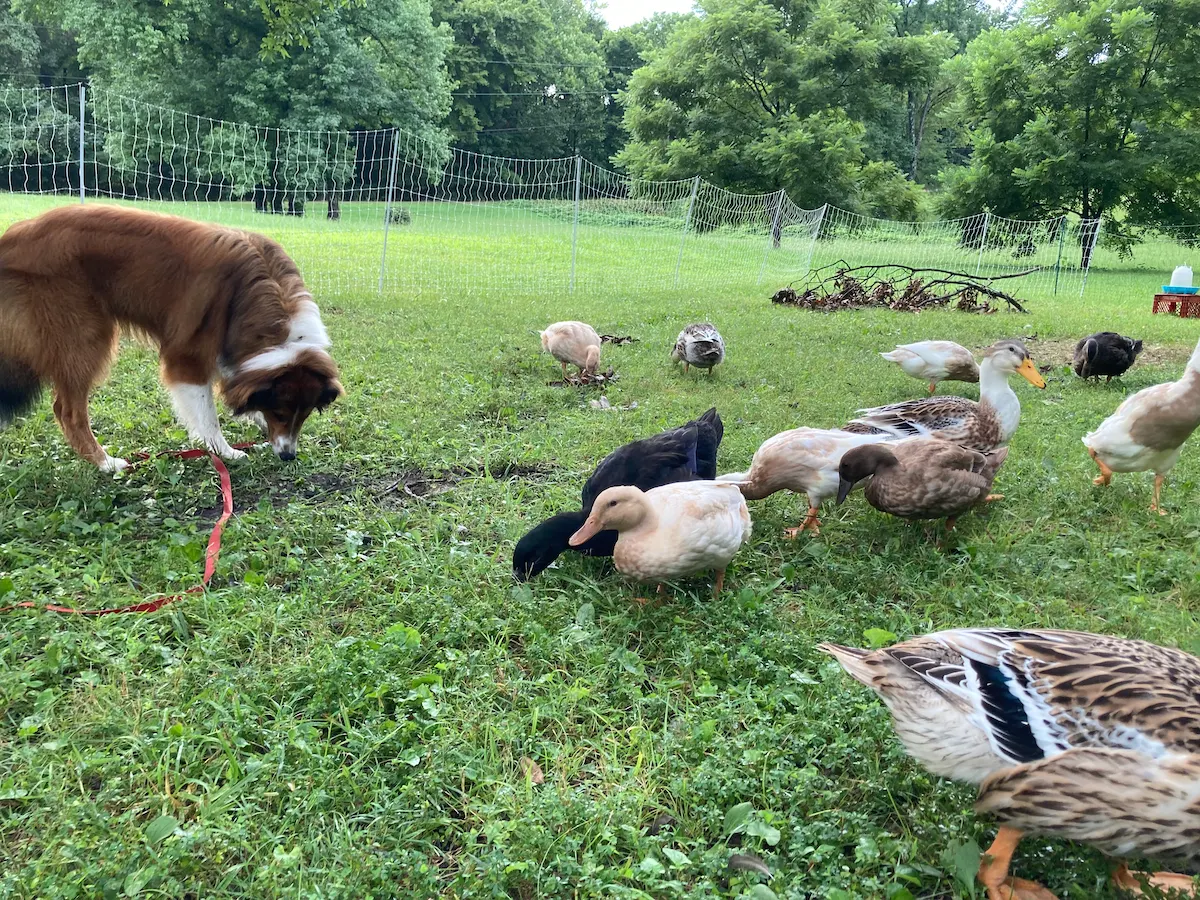
I keep my two Old-Time Scotch Collies, Lennox and Maisie, alongside a mixed flock of about 15–20 ducks and several chickens. Over the last three years, I’ve seen where a herding breed actually earns its keep around poultry—and where it doesn’t. This post is a look at my own experiences, as well as observations from others’ experiences. I focus on what farm collies do better than livestock guardian dogs, what they can’t do at all, and recommendations on how to decide which type of working dog would do best with your backyard flock.
What is a livestock guardian dog (LGD)?
Livestock guardian dogs are a group of dog breeds that have been bred to protect livestock. They are commonly used to guard vulnerable animals like sheep and lambs, who have very little defense against predators.
LGDs are known for their independent but calm nature. They are often seen lying about, and it’s easy to think these dogs are off the clock. But the moment a potential threat appears, these dogs are on their feet.
Common LGD traits
Here are some general characteristics that define LGDs:
- Alert all night: These dogs tend to be more active at night, when predators are more likely to attack.
- Barkers: An LGD tends to make a lot of noise, especially at night. Their goal is to warn predators before they get close—eliminating the need for an actual fight.
- Independent: They think for themselves, which can make training difficult.
- Calm: These dogs need to stay calm around small or even injured animals. While they generally do not need a lot of activities to keep them occupied, you can still expect regular dog behavior like digging.
- Roaming: LGDs were bred to patrol large areas, and that instinct remains very strong! While certain breeds do better on smaller acreages, it is vital to have high-quality, secure fencing for guardian breeds.
Common LGD breeds
When most people think of livestock guardians, they often imagine Great Pyrenees. These are the most common guardian dog breed in the US. These dogs are popular for their calm demeanor and ability to do well with kids and families.
Some other common LGD breeds include:
- Anatolian Shepherd
- Akbash
- Maremma
- Karakachan
- Kangal Shepherd
If you’re considering getting a full-time livestock guardian, be sure to research different breeds so you can find the best fit for your homestead.
If you’re not running a large operation, spending years raising multiple LGDs may not be feasible. The good news: your predator load and acreage are probably smaller than a working ranch’s, too.
What it takes to raise a working LGD
Before you go out and buy a fluffy Great Pyrenees puppy, understand what full-time guardian work actually requires.
These breeds are slow to mature and generally aren’t ready for full-time guard duty until around 2–3 years old. That’s a long stretch of training and bonding with a large, independent dog.
And even once an LGD is mature, it’s widely recommended to keep a minimum of two dogs. With only one guardian, there’s always a chance the dog leaves to investigate a threat and leaves the flock undefended—or, worse, meets something it can’t handle alone.
If you’re not running a large operation, spending years raising multiple LGDs may not be feasible. The good news: your predator load and acreage are probably smaller than a working ranch’s, too.

Farm collies vs. livestock guardian dogs at a glance
Here’s how multi-purpose farm dogs and LGD breeds compare across the decisions that actually matter on a small homestead:
| Consideration | Multi-purpose farm dog | Livestock guardian (LGD) breed |
|---|---|---|
| Primary role | Some protection, herding, and vermin control | Full-time guardian |
| Fencing concerns | Must keep large predators out | Must keep the LGD in |
| Aerial defense | Tracks birds of prey | Only notices birds of prey when they attack |
| Place in the family | Bonds with owner | Independent |
| Predators they can handle | Rodents, opossums, raccoons, and foxes | Deters dogs, bears, and large predators (when paired) |
| Space needed | Minimal, under an acre | Large acreage |
| Biddability | Excellent | Poor |
What dog breeds do best with poultry?
No breed was developed specifically to protect poultry. If you’re looking for a purpose-built chicken guardian, it doesn’t exist.
Poultry are very different from mammals, creating another layer of separation from your dog and your chickens. This can make it difficult for dogs, even ones bred to protect small animals, to take to protecting your backyard flock.
So the more useful question isn’t “which breed guards chickens best?” It’s “what type of dog do I want to spend time training?”
Why herding breeds were once the default homestead dog
When I think about the dog I want to spend years training, it’s one that wants to spend time with me and wants to make me happy. That’s the definition of a herding dog. Guardian breeds were bred to bond with the animals they protect and patrol alone through the night—herding breeds were bred to work in partnership with a handler.
That partnership instinct has deep roots in protection work. Herding breeds like German Shepherds were often used to contain livestock to an area, acting as a living fence—and because they were the fence, they were also the first line of defense. Other breeds, like collies, moved livestock through the night. Those dogs had to stay aware of threats, alert the shepherd to anything suspicious, and might even deter or eliminate smaller predators like foxes.
Today, heritage herding breeds have ancestry with those same collies. Before large-scale farms were common, these farm collies were prized for retaining herding instinct while still protecting livestock. Not every herding dog can do both—but on a small farm, a dog that can is invaluable.

What are multi-purpose farm dogs?
Multi-purpose farm dogs most commonly fall under two breeds: Old-Time Scotch Collies (OTSCs) and English Shepherds. However, there are some dogs that a farmer may simply label as “farm collies,” and while they may originally have been one of those two breeds, they are simply good farm dogs.
It’s also possible for other herding breeds like Australian Shepherds and Border Collies to be registered as American Working Farm Collies, an association that works to preserve multi-purpose farm dogs. To qualify as an American Working Farm Collie, the dog must show an aptitude for at least two of three types of work: herding, guarding, and hunting.
Many breeds and types of dogs can function as multi-purpose farm dogs. Still, it can be helpful to start with breeds that have a low prey drive around poultry and perform multiple tasks on working farms.
Where multi-purpose farm dogs outperform LGDs for poultry
Knowing their limitations, you might wonder why anyone would choose a dog that has to come inside at night and can’t fight off a pack of stray dogs. Farm collies genuinely aren’t the right answer for large-scale operations. But if your priority is protecting poultry, they can outperform an LGD in three specific ways.
Protection against aerial predators. For poultry owners, this is the biggest advantage. Many farm collies naturally track birds of prey. LGDs are far less likely to register something in the sky as a threat until it attacks. I’ve routinely watched my OTSCs spot and run off large birds before they became a real problem.
Getting birds up at night. Chickens aren’t easy to herd, but I’ve heard repeated accounts of herding dogs that make sure every chicken or duck makes it into the coop before dark.
Staying close. Herding breeds want to stay near their people, so they do much better on a small acreage. While you still need a good fence, you don’t have to constantly worry about it wandering miles down the road.
Size, bite force, and where farm collies stop
Most farm collies are medium-sized. You’ll occasionally see one in the 80–90 lb range, but it’s more common for these dogs to come in under 60 lbs. A Great Pyrenees typically runs 85–115 lbs, with some males considerably larger.
Livestock guardians were also bred specifically to face large predators like wolves and bears. Most LGD breeds have very strong bite force and can do serious damage in a fight.
Farm collies should never be asked to defend against large predators. They simply are not physically large enough to be successful against a pack of dogs or other large threat.
Overnight protection strategies
Night is the real concern, and it’s when you’ll be asleep and unlikely to hear or see an attack. Many people—myself included—bring their multi-purpose farm dogs indoors overnight.
That means your overnight protection strategy needs to be structural:
- Secure housing. All livestock go into a coop or secure barn where predators can’t reach them.
- Electric fencing. This can be a worthwhile second layer, especially if you have large predators (like bears) capable of destroying outbuildings.
- A good perimeter fence. This one pulls double duty. Even with the dog inside at night, you still have daytime threats to think about—most often stray dogs. A high-quality fence protects your farm dog and your livestock.

Why the individual dog matters more than the breed
Every dog is different. Even a dog from strong working lines is no guarantee it will excel on your farm.
This is why it’s worth working with a breeder who introduces puppies to livestock early and tests for working instinct. A good breeder can steer you toward the individual puppy with the traits you actually need—aerial awareness, low prey drive around poultry, biddability—rather than just the breed.
And even with the right instincts, raising a reliable farm dog takes time and patience, especially if you don’t have an older dog for the puppy to learn from.
How to train a dog to protect poultry
Training any dog around poultry is a slow, repetitive process. Here’s the short version:
- Introduce slowly. Teach impulse control by correcting your dog the moment they get overexcited or start to see poultry as prey.
- Testing around high-energy environments. Spend time testing responses to chickens running, ducks splashing, wings flapping, etc. You’re training your dog to know that these activities don’t mean they need to activate a prey drive.
- Add freedom gradually. Use a long leash so you keep control while letting the dog follow you during chores.
- Supervise off leash. Keep a herding stick or sorting paddle handy in case you need to intercept a chase.
- Give each species its own space. Even with a fully mature, trustworthy dog, give each species an area the other can’t access—especially at feeding time. Never put your dog in a position where it feels it has to guard food from livestock. LGD “jump gates” are designed specifically to give dogs access to different areas, without allowing livestock to follow.
With the right dog, a lot of this comes naturally. With the wrong one, it’s a long road. Either way, this full guide to training your dog around day-old chicks and ducklings will help you along the way!
How to choose the right dog for your homestead
It comes down to three variables: your acreage, your predator pressure, and what you want out of the dog.
- Large acreage, large predators, livestock beyond poultry? A pair of LGDs, and a plan for the multi-year training timeline.
- Small property, hawks and foxes as your main threat, birds secured at night? A farm collie or similar herding breed will likely serve you better.
- Somewhere in between? Weigh whether you can realistically install secure fencing for two guardian dogs. If not, build your night security into the coop and get a dog you’ll enjoy training.
Want practical training tips?
If you’re looking for simple, practical ways to train your homestead puppy, check out our free guide: 5 Exercises to Train Your Homestead Puppy. In this guide, you’ll learn daily exercises that help train a reliable, all-purpose homestead dog.
Frequently Asked Questions
What is the best dog to protect chickens from hawks?
Many heritage herding breeds (like Old-Time Scotch Collies and English Shepherds) instinctively track birds of prey and deter them before they become a threat. Livestock guardian breeds generally won’t register a hawk as a threat until it’s already attacking. A reputable breeder can help you identify puppies most likely to excel at aerial defense.
Can a farm dog replace a livestock guardian dog?
Not entirely. A farm collie or similar herding-type farm dog can protect livestock from small predators like rodents, raccoons, and foxes, but it isn’t large enough to handle big threats—including stray dogs. A pair of LGDs gives you dependable 24/7 coverage. A multi-purpose farm dog gives you daytime aerial defense and small-predator control.
What predators can a herding-type farm dog protect chickens from?
Herding-type farm dogs do well against aerial predators like hawks, and against opossums, raccoons, and foxes. Many farm collies are also exceptional ratters, which keeps vermin from overrunning your barn. This can be a real benefit even though rats aren’t usually a direct threat to adult birds.
Can livestock guardian dogs live on a small acreage?
Yes, with three conditions. They need enough mental enrichment to avoid destructive behavior (a hole-digging LGD on a small property becomes a problem fast). They need fencing strong enough to prevent roaming. And they need to contain their barking to areas far from your neighbors’ bedroom windows. The last one is a bit of a joke, but part of an LGD’s job is deterring predators through warning barks. If you live close to neighbors, this can quickly cause friction!
How do you know when a dog can be trusted around chickens?
Test in multiple ways before ever leaving them alone. Some people pretend to leave, only to stay close and monitor the dog on a camera. There are plenty of variations on this, but ultimately it’s repetitive, ongoing training—not a single test—that produces a reliable dog by the time they’re fully mature.


Leave a Reply