
Intro
Preparing for a homestead puppy requires gear built for mud, livestock safety, and, perhaps most important, keeping your sanity! Before bringing your farm puppy home, prioritize waterproof training gear (like a Biothane long line and herding stick), durable indoor containment, basic grooming tools, and mental enrichment toys to manage high energy and teething safely around livestock.
If you’re preparing to bring home a new homestead puppy, these supplies can help put you on the right path! These are tools and supplies I have personally used and, oftentimes, wish I had bought earlier. The first section focuses primarily on outdoor, homestead gear for your dog. But if your dog will be staying indoors with you, the following sections will help you stay sane while adjusting to a rambunctious, mouthy, and immature working breed. (Yes, they are cute—but they are a lot of work too!)
Whether you are bringing home an Old-Time Scotch Collie, an English Shepherd, an Australian Shepherd, or a working cross, here is the essential, farm-tested gear you can have ready before day one.

Note: This post contains affiliate links for gear we actually use and trust. If you make a purchase through these links, we may earn a small commission at no extra cost to you. Thank you for supporting Lennox & Co.!
Durable gear & outdoor tools for herding puppies
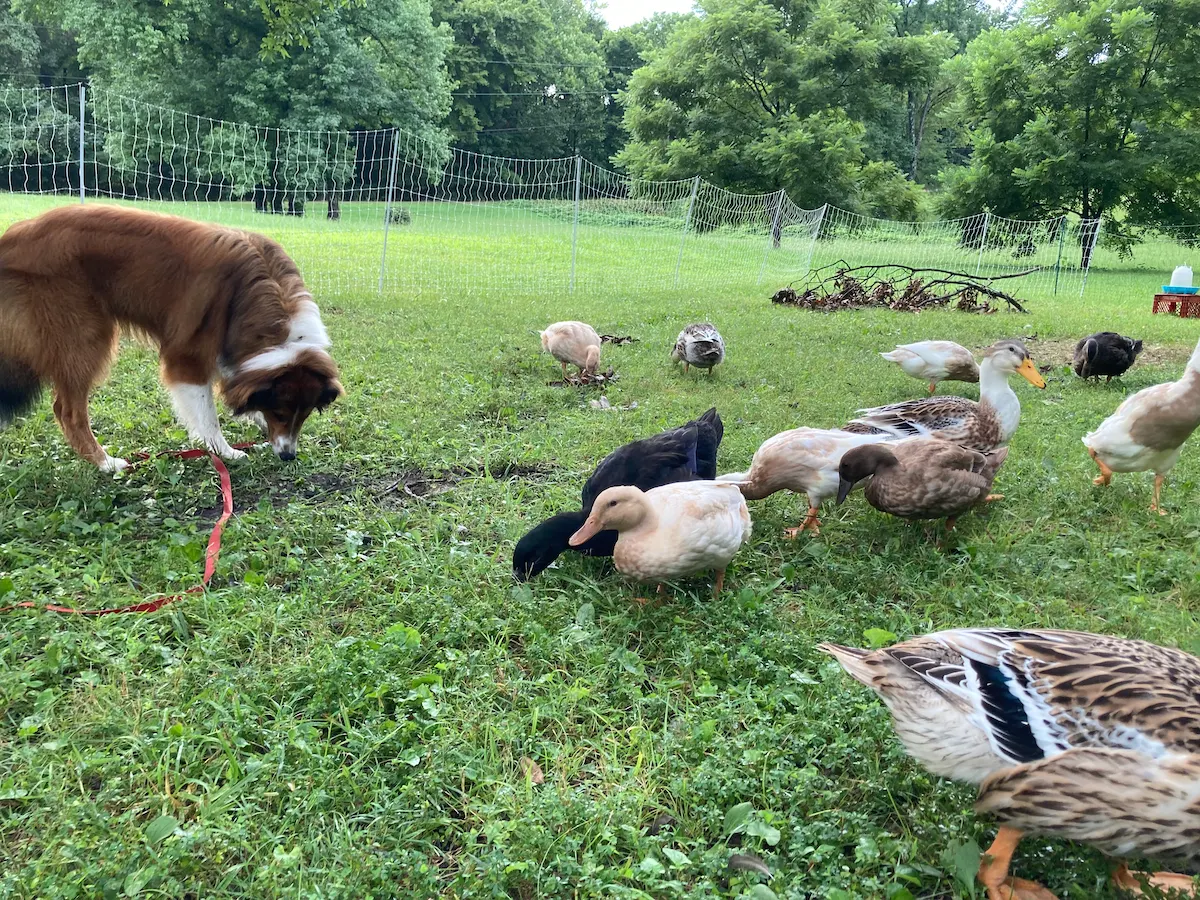
I’ve used many of these to train my dogs to poultry, at herding lessons, or off leash. If you’re looking for training tips with poultry, these are the training steps I use.
- Waterproof Biothane long line (15 to 30 feet): A standard nylon leash quickly gets soaked and muddy. A Biothane long line is completely waterproof, odor-proof, and easily wipes clean after being dragged through wet pastures. More importantly, a long line is your single most critical safety tool for training off-leash responsiveness—especially around livestock. It allows your puppy to explore farm boundaries and observe poultry while giving you full control to correct unwanted behavior.
- Flat collar: A simple, durable flat collar made of Biothane is easy to clean and durable. For herding lessons, instructors generally request that your puppy wear a flat collar. Herding breeds are sensitive and biddable, so a more severe collar is rarely necessary.
- Herding stick (or rake): A lightweight herding stick, sorting paddle, or even a shrubbery rake can act as an extension of your arm. This is an invaluable tool when you are introducing your herding puppy to livestock. If your dog becomes over excited, you can simply ask them to pause by blocking their path with the rake, stick, or paddle.
- On-the-go water bottle or portable bowl: Farm chores take time. Keep a portable water bottle or collapsible bowl so that your puppy has access to water, especially when you are training off property.
- A basic leash you can tie: Keep a heavy-duty 6-8 foot leash on hand that can be easily looped or tied around a fence post or gate while you fetch feed or handle chores hands-free. (Training your dog to be calm when tied is also a very important skill to train while they’re young.) I personally like using horse leads since they are durable and easy to tie.
- Flirt pole: A flirt pole (similar to a lunge whip with a lure attached at the end of the line) is an incredible tool for training herding breeds. It allows you to build impulse control, drop-it cues, and drive redirection in a controlled setting—before ever introducing those instincts to live animals. This is also a great way to reward puppies without treats!
- Temporary play pen: If you have cattle panels laying around, these can work well for a temporary set up. Otherwise, I highly recommend getting dog fence panels that allow you to safely let your dog observe poultry or other livestock—while you complete chores.
I’ve used these fence panels to create “brooder corrals” and other containment areas for training—see exactly how I use them in this step-by-step training guide on how to train your herding dog around chicks.
The temporary panels can also be used indoors, which can be incredibly helpful when your dog is muddy and needs to dry off (or just needs some quiet time).
Indoor house training and daily essentials
- A crate or kennel: A sturdy crate provides a quiet, low-stimulation environment for downtime. While you may be excited to bring your puppy along for all the activities, puppies still need a lot of sleep. Kennels give them the space to settle without distractions. They can also be incredibly helpful for potty training, since puppies don’t want to dirty the same area they are sleeping in.
- Potty pads: These are useful in crates or playpens, especially overnight. When you first bring your puppy home, they likely won’t be able to hold it all night.
- A plethora of treats: Get small, low-calorie treats or high-quality feed for regular training sessions. High-value treats may be needed when you’re outdoors or in distracting environments, so it’s helpful to have a variety on hand!
- Ceramic or heavy-bottomed bowls: Lightweight bowls get flipped over easily, and before you know it, your floor and your puppy are soaked! Get heavy ceramic or weighted stainless steel bowls to keep water from being tipped over. Hanging bowls can be a great option for contained areas like kennels or play pens since they are off the ground.
Basic farm dog grooming supplies
- Soft brush: Most herding breeds have a lot of fur, so it’s important to spend time getting them used to being brushed. Choose soft brushes (yes, brushes made for people can be a great choice!) and focus on making the brushing enjoyable. While more expensive, the Chris Christensen dog brushes do seem gentler, and I highly recommend getting a small brush for training as well as matted areas and around legs.
- Nail clippers: If you don’t already have some dog nail clippers, you’ll eventually want a pair.
- Electric clippers for paws: If you’re getting a collie or another fluffy breed, you will need some grooming tools to keep your pup’s paws from turning into fluff balls.
- The Stuff detangler: This is a fantastic detangler for dogs with long, thick coats. This can be great to have on hand for when your dog goes charging through the brush and comes back with loads of tangles. Cowboy Magic is another highly-recommended detangler.
Essentials for teething (and a happy homestead puppy)
Herding breeds are renowned for their mouthiness, especially during the teething stage. To help them focus on appropriate things to bite, it’s helpful to have plenty of puppy-appropriate treats, chews, and games available.
Snuffle mat: These snuffle mats engage and encourage the development of your puppy’s sense of smell. Scent work can be a great way to tire out a dog on days when you can’t get outside as much as you’d like.
Teething rings: I used these a lot with my puppies. They were the perfect amount of chew for very young puppies, and they were a great treat for kennel time or helping the puppies settle.
Pig ears: This is one of the few natural, high-value chews that are safe for young puppies (although you still need to be sure that your dog doesn’t swallow a huge bite). These provided some of the longest-lasting entertainment for my young dogs.
Tendon chews: This is another long-lasting, natural chew that keeps puppies occupied for extended amounts of time. These can be a bit more difficult than the pig ears, so I started feeding tendons once my puppies graduated from pig ears.
If you want to see your dog spin his treats (like Lennox did in the video above), be sure to get a bully stick holder!
Chicken feet: These can be a high-value treat, although these never lasted long with my dogs, even when they were young!
Wobble feeder: A food-dispensing toy that activates your dog’s herding instincts! I used to feed Lennox exclusively using this toy. He absolutely LOVED it, and it gave me a good 20 minutes of peace! This is by far one of the best toys I have ever bought.
Classic Kong: There are many variations of this classic toy, but all of them provide a way for you to keep your dog occupied—which can be especially helpful when the weather’s bad or you simply have a busy day. You can stuff the toy with canned pumpkin, wet food, yogurt and peanut butter, or other treats. If you want to make it last even longer, you can freeze it ahead of time to make it more challenging.
Ready to Start Training?
Having the right gear is the easy part! If you’re looking for simple, practical ways to train your homestead puppy, check out our free guide: 5 Exercises to Train Your Homestead Puppy. In this guide, you’ll learn daily exercises that help train a reliable, all-purpose homestead dog.



Leave a Reply