
Summary:
Most herding breeds can learn to live safely around chickens, but how you get there depends on where you’re starting—a new puppy meeting an established flock is different than a grown dog meeting day-old chicks. In every version the goal is the same: reward calm behavior and gradually increase your dog’s freedom. Plan on weeks (or even months) of supervised, on-leash work before the first unsupervised minute.
Find your starting point below and skip to the part that applies to you.
| Where you’re starting | What you’re working on | What lets you advance | Start here |
|---|---|---|---|
| New dog, established flock | On-leash exposure at a distance | Dog is relaxed and listens to you when around chickens or ducks | Supervised exploration |
| New poultry, adult dog | Establishing that chicks are now part of the family and routine | Dog safely interacts with young chickens or ducks on a loose leash | Start at day 1—read it as a first-week plan, not a puppy plan. |
| Both new—young poultry and a puppy | Developing routines around poultry training, teaching calm behavior around poultry | Puppy consistently responds to vocal commands when around poultry | The top of the post. Read straight through. |
The best time to start training your herding dog is while your poultry are still young. If you are bringing home day-old chicks or ducklings, this will guide you through three stages of training your herding breed to young poultry that are still delicate and vulnerable. In fact, the first two steps are specifically meant for training while your chicks or ducklings are still confined to a brooder box.
Training livestock guardian breeds (LGDs) vs training herding breeds around young poultry
This guide specifically looks at how to train herding dogs around young chicks or ducklings (although it can be applied to most any dogs). You will notice, however, that it is very different from most guides on how to train livestock guardian dogs (LGDs) around poultry.
That’s because I followed those guides with my first dog, Lennox, and later discovered that I had crushed his confidence when it came to herding. Since I want my dogs to retain their herding abilities—while remaining calm and gentle around young, vulnerable poultry—I changed my training methods with my second dog, Maisie.
This is an overview of what I’ve found to work with my dogs. I’d love to hear if you’ve had success with other methods that still encourage your dogs natural herding abilities!
I had crushed his confidence when it came to herding … so I changed my training methods with my second dog, Maisie

Starting day 1: How to desensitize your herding dog around young poultry
So you’ve brought your chicks or ducklings home—what now?
This is a critical time to begin training! Don’t wait until your poultry is older. Young poultry are much easier to contain and handle, which makes it easier for you to show your dog that these babies are yours and they need to be protected.
These are YOUR chicks (or ducklings)
For the first couple of days, take your dog with you to visit the brooder box. Keep your dog on a leash. If you’re able to safely drop the leash, that can take some of the tension out of these training sessions, but you still want it on in case it’s needed. I recommend bringing treats to reward relaxed behavior (like lying down).
The goal of these sessions is to show your dog that these are YOUR baby chicks or ducklings. Don’t let your dog stick its nose in the brooder box. If you pick up a chick or duckling, demand your dog give the baby poultry space.
Once your dog knows to respect this boundary and is completely relaxed—as in, chooses to sit and lay down next to the brooder box—you’re ready to move to the next step. (Even if your dog gets this after a single session, I recommend practicing this for at least two days.)
Give your herding dog a new responsibility
Once your dog respects that the chicks or ducklings are yours (and knows they are not food), your dog may naturally take up guardian behavior.
You may think, my border collie was bred to herd, how would it know to guard? The reality is that most herding breeds originally were bred to also protect livestock if needed. According to the American Kennel Club (AKC), “These breeds (herding breeds) were developed to gather, herd, and protect livestock.” Why else would herding breeds be a common choice as protection dogs?
Begin giving your dog a little more freedom as you visit the brooder box. Let them do some sniffing. My Scotch Collies are natural observers, so they tend to sit next to the brooder box and watch the poultry.
My second dog, Maisie, absolutely LOVES checking on the baby chicks or ducklings. She will whine to go see them, then take up her spot as guardian, simply sitting next to them and keeping an eye on things. She does do some sniffing, and if you notice your dog sniffing one chick more than others, you may want to pay attention—Maisie would spend more time sniffing a sick chick.
If you’re looking for a dog like Maisie who has the natural instinct to protect and gently work poultry, start by understanding which herding breeds have the lowest prey drive around poultry. It will put you on the right track to finding the right dog for your flock!

What if my herding dog doesn’t display any guardian behavior?
So long as your dog is not too boisterous around your poultry, it’s not necessary that they feel a sense of responsibility to protect your young chicks. Right now, you just want relaxed behavior. If your dog is not relaxed, you may need to go back to step one or actively work on training exercises (asking for sit, down, stay, etc.) around the brooder box.
If you’re wanting your dog to provide some protection to your poultry, read my honest guide on what a herding breed can (and can’t) protect your flock from.
Field Note
Any time you bring your dog with you to be around your poultry, check your body language and emotions. This may sound weird, but animals pick up on these nonverbal cues very quickly.
You want your dog to be relaxed around your chickens or ducks, which means you need to be relaxed and confident. Have a plan in place so you know exactly how you will calmly handle a situation if your dog decides to stop listening to you (this is also why it’s recommended to keep a leash on!).
Supervised exploration: Train your dog to not chase chicks or chickens
If possible, I enjoy seeing how my dogs interact with chicks or ducklings while they are still fairly small, but big enough to start exploring outside of their brooder.
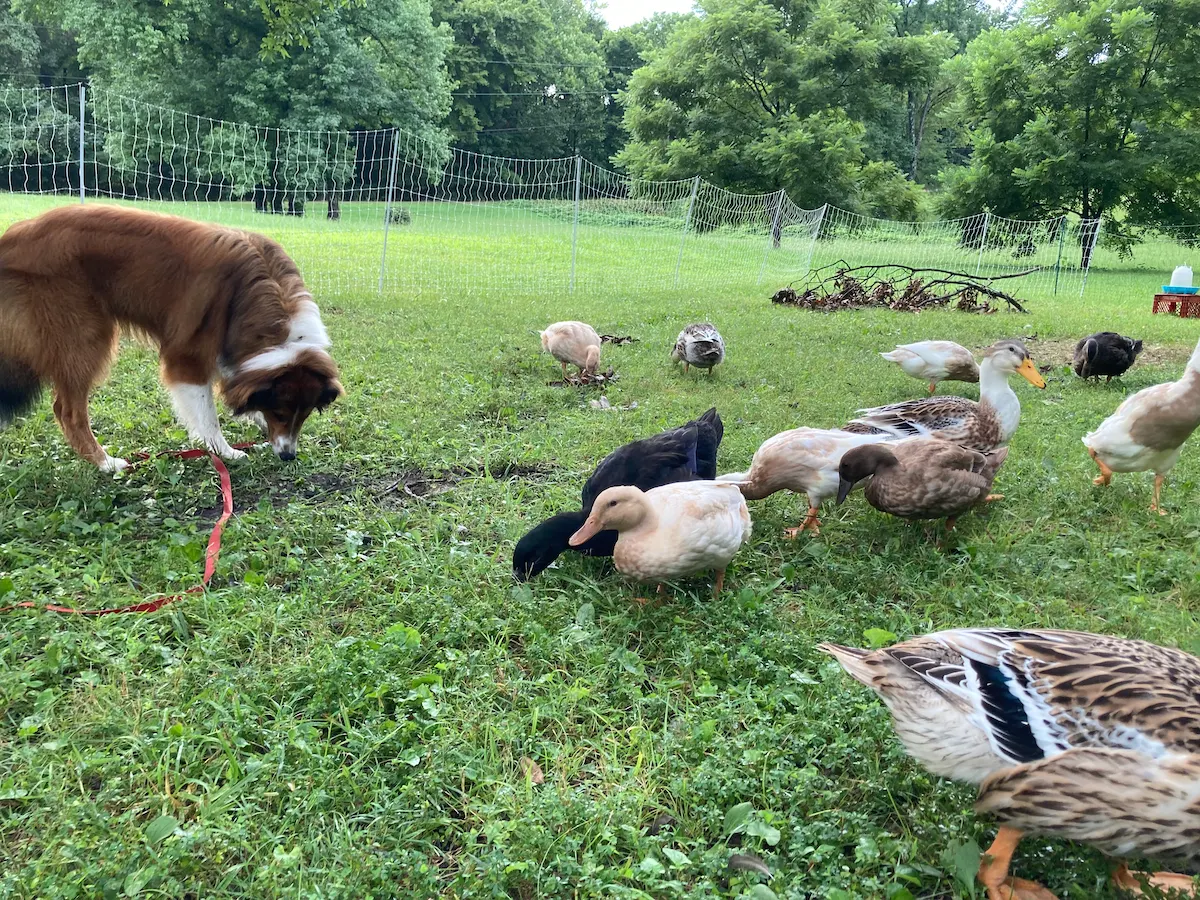
If you are still training your dogs, I always recommend working with one dog at a time. I let my chicks or ducklings explore a smaller fenced area (like a large “chick corral” or chick run), and then give my dogs the ability to explore with them.
What is good behavior for a herding breed around chicks and ducklings?
For me, some sniffing, gentle following, and low-energy interest is actually good behavior. This is where my training differs from traditional LGD training. Sometimes it is easier to train strictly for LGD-type behavior, because you don’t want ANY interest in the poultry. It’s easier to draw the line.
Keep in mind that Scotch Collies and rough collies have a “gentle eye,” meaning that they don’t have the border collie stare. Instead, they tend to gently push livestock. Other breeds like border collies will probably act a little different than my dogs, and you may choose to wait until your poultry is full grown to introduce them outside of a brooder box.
What are signs that my herding dog sees chickens as prey?
Signs your dog sees chickens or ducks as prey include:
- Shaking or trembling
- Slobbering, licking, or salivating
- Panting
- Whining
- Locked focus—a hard stare and does not listen to you
While some of these, like whining and panting, can also be signs of stress, it can still be a good reminder to take things slow.
How to respond to prey-driven behavior
If your dog shows any of these behaviors at any point, immediately redirect their energy. Redirection can look like:
- Reprimanding your dog: This could be a verbal “No,” a tug on the leash, or whatever you know works for your dog.
- Asking for a preferred behavior: I will often ask for a “back out” if they are too close to my poultry. I also keep treats, so they know they will get rewarded for giving the chicks or ducklings space.
- Changing activities: Be careful with this one since you don’t want to reward unwanted behavior. I think it is perfectly acceptable to leave the area, refresh, and try again later—especially if you also need a break. However, I would be careful about redirecting by getting a toy out, etc. as this keeps energy high and can be seen as rewarding the unwanted behavior.
You can also find links to some of the training tools I use when training excitable dogs to poultry. These primary include a long line, herding stick, and temporary fencing.
Taking a step back: What to do if your dog is chasing chicks or ducklings
If your dog is too excited, remember that you are in control. When first introducing your dog to your poultry, you should be holding onto your dog’s leash. Simply take some time to refocus your dog by asking for them to sit, lay down, etc.
If your dog continues to have too much energy around your young poultry, this may be all you do with these training sessions. Remember you can always go back a step. It’s better to take things slow than to get frustrated and blame your dog for the unwanted behavior.
Which herding breeds take to poultry best?
I have Old-Time Scotch Collies, a heritage breed of farm collie. This training style worked for us, but every dog is different. You will need to use what you know about your dog—and what your goals are for your dog—and decide the best training method for you. Oftentimes, that’s a mix of several training methods.
If you’re interested in getting a herding breed, be sure to learn which herding breeds are most likely to do well with poultry.
Disclaimer
My dogs have relatively gentle herding styles, which works well for poultry. A more aggressive herding style that is NEEDED for cattle may not be appropriate for poultry. If this training style is not working, you may need to decide whether to:
A) Train your dog more like an LGD (and discourage its herding instincts)
B) Keep your dog separated from your poultry, but encourage its herding instincts
Neither of those options are a sign of failure! They are a sign that you understand your dog’s capabilities.
I want to put my personal training experience out since I know a lot of people are told herding dogs can’t herd and be relaxed or even protective around poultry. My experience has told me otherwise.
What comes next: outside, free-ranging, and off-leash
Whether you work with chicks in a brooder box or temporarily contain adult chickens for training purposes, at some point, your chickens are running around in a less controlled environment.
Out of the brooder and into the coop, run, or fenced area
Keep the same training mentality in mind. Keep a leash on—if in a larger area, a long line is a good idea until you’ve built trust with your dog. I treat this time as general training. Practice basic commands, while letting the ducks splash or the chickens squawk in the background.
To start, practice basic obedience in an area not directly next to the chickens. After several sessions of this, you may gradually increase how close your dog is to the chickens.
For more advanced training sessions, you can ask your dog to stay in “place” while chickens run by for scratch. Then practice recall when the ducks are splashing close by. Until you are confident in your dog, it’s best to keep a leash on so you don’t let your dog be “rewarded” if they choose to go after the chickens instead of listening to you.
Of course, I highly recommend using treats to reinforce good behavior throughout this process.
What happens when chickens have the whole yard?
Once you are confident that your dog will listen to you even when your chickens are flapping, running, and being chaotic, you can slowly increase the size of the area where you train your dog—and eventually let your chickens free-range while your dog is out with you.
Routine is your friend—repeat all the training you did before (recall, stay in place, etc.) but in a bigger area with more options. Again, having a long line will be a very helpful tool at this stage!
You also want to build a routine around daily chores. Have your dog follow you as you let the chickens out, collect eggs, etc. At first, you may keep a close eye on your dog, but gradually you may realize that your dog is becoming a dependable companion.
Having your dog follow you during chores can also be great because you are not solely focused on your dog—which should mean you are not holding as much tension. That can be very helpful if your dog has picked up on your anxiety or tension in the past.
Off-leash and unsupervised: When is your dog ready?
A dog is ready for off-leash, unsupervised time with the flock when you can check off these three things: they behave the same regardless of whether they think you’re watching, they’ve been tested around birds in more than one setting, and they have somewhere to put their energy other than your flock.
A dog with no other outlet for their energy will find a job, and your flock is the most interesting job in the yard.
It’s important to note that reliable recall helps a lot during training, but it isn’t what keeps birds safe once you’re out of sight. Every dog is different, and you need to spend enough time training your dog to understand their prey drive and maturity around chickens.
Here are some general checklist items that can help you decide if your dog is ready to spend time alone and off-leash with your flock. The one I’ve found most important is what I’m labeling “integrity and consistency.” This is evaluating whether your dog behaves the same way when they think you aren’t watching.
| Factor | Goal | Importance |
|---|---|---|
| Experience | Your dog has trained in multiple settings around chickens | Deal-breaker: your dog needs to know how they should behave |
| Integrity and consistency | Your dog behaves well even when they think you’re not watching | Deal-breaker: your dog needs to pass some “tests” before you trust them completely with your flock |
| Energy and mental exercise | Your dog has a way to burn energy outside of chickens | Important: High-energy dogs can quickly become destructive when bored |
| Age | Your dog is at least 2 years old | Important: Dogs can need “re-training” as they mature—watch for signs of training regression as a young dog matures |
| Natural disposition | Your dog has shown little or no prey drive around chickens | Helpful: A dog that naturally does well around chickens accelerates this checklist |
| Recall | Your dog has reliable recall in all situations | Helpful: Important for training, but unsupervised means you can’t step in anyway |
Some people would list other items, like “never chases chickens,” but, as I said earlier, I’ve decided to let my dogs be herding dogs. If that herding turns into a prey-driven chase, then that’s a problem—but I do allow some gentle herding.
Again, it’s ok if your dog never reaches the stage where they can reliably be left alone with your chickens. Your bond with your dog is still strengthened by positive training experiences, and hopefully you can still enjoy your chickens with your dog close by (and supervised).
What success looks like when you train your herding breed around chickens or ducks
Working with animals requires patience. There is no crossing something off a list and never thinking about it again.
I’ve loved seeing how fiercely protective Maisie is of our new chicks and ducklings.
And I’ve loved seeing how calm and relaxed Lennox can be around my flock.
While I trust them 90% of the time, I still don’t leave them outside all day by themselves (mostly because we don’t have great fencing yet). But I know that I can go about my chores with my dogs, and they will behave around my poultry. And if I ever need to give a reminder that I don’t like a behavior, I know how to communicate with them. And that’s a great feeling.
To me, success is improving the bond with my dogs.
Common questions about dogs and poultry
Can I train my dog to be gentle around chicks?
Yes! Start by establishing that these are YOUR baby chicks (or ducklings!). After a couple days of showing your dog that these are delicate babies that need to be protected, you can begin to gradually let your dog peek in the brooder.
Reward gentle behavior—and have a plan for how to keep your dog’s energy low and calm.
Why is my herding dog whining at baby ducklings or chicks?
There are a few main reasons your dog is whining at young chicks or ducklings:
- Your dog is overexcited and potentially even sees these chicks or ducklings as prey—this may be accompanied by trembling, slobbering, or other over excited behavior. Redirect your dog’s attention immediately.
- Your dog is a natural protector and is excited to get to work! If your dog primarily whines when it knows it is about to visit the brooder box, but stops after inspecting “its” babies, this is a sign that your dog has adopted these babies and wants to make sure they are safe.
- Your dog may be anxious and unsure what to do. Keep training sessions short and avoid overstimulating your dog. You may need to go back a step in training so your dog can become more comfortable with their new role.
How early can I begin desensitizing my dog to baby chicks or ducklings?
You can begin desensitizing your dog as soon as you bring home your day old chicks or ducklings!
I highly recommend establishing that these are your babies from day 1, while the chicks or ducklings are easy to contain and handle.
How to desensitize my dog around baby chicks or ducklings?
Desensitization takes time and patience. Start with short, frequent visits to the brooder box. Gradually give your dog more freedom to sniff and inspect the young poultry.
Remember to keep your dog on a leash and bring treats in case you need to ask your dog for a “better” behavior (like asking your dog to “back out” to give the chicks more space).
How to stop dog from fixating on baby chicks or ducklings?
If your dog is fixated on baby chicks or ducklings, watch for signs of an active prey drive, like trembling and slobbering.
If your dog is viewing your young poultry as prey, make sure you redirect that energy (often, completely leaving the area can be a helpful reset).
However, some dogs are natural protectors. If your dog is gentle around your young poultry and listens to your when you give commands, I don’t see any reason they shouldn’t be diligent watchers and guardians.
How to safely show baby ducklings or chicks to your dog?
Only show baby ducklings or chicks to your dog after you’ve taken a couple days to establish that these are YOUR animals, and they need to be protected.
Once your dog respects that, you can begin to slowly let them sniff the brooder box and even individual chicks (ideally while you are holding them).
Ultimately, the safest way to introduce your dog to young chicks or ducklings is slowly. Take your time!
How to safely introduce a puppy to baby chicks or ducklings?
While it can be great to start training your puppy to livestock early on, it can be helpful to have an older dog that can help with that training.
Otherwise, the same steps can be applied to puppies, just move extra slowly. Puppies are not mature and can be much more playful—they also don’t always know how to be gentle. Make training sessions short and keep an extra close eye on your puppy.



Leave a Reply